

At 14.72% CAGR, Precision Medicine Market to reach USD 456.81 Billion by 2035.
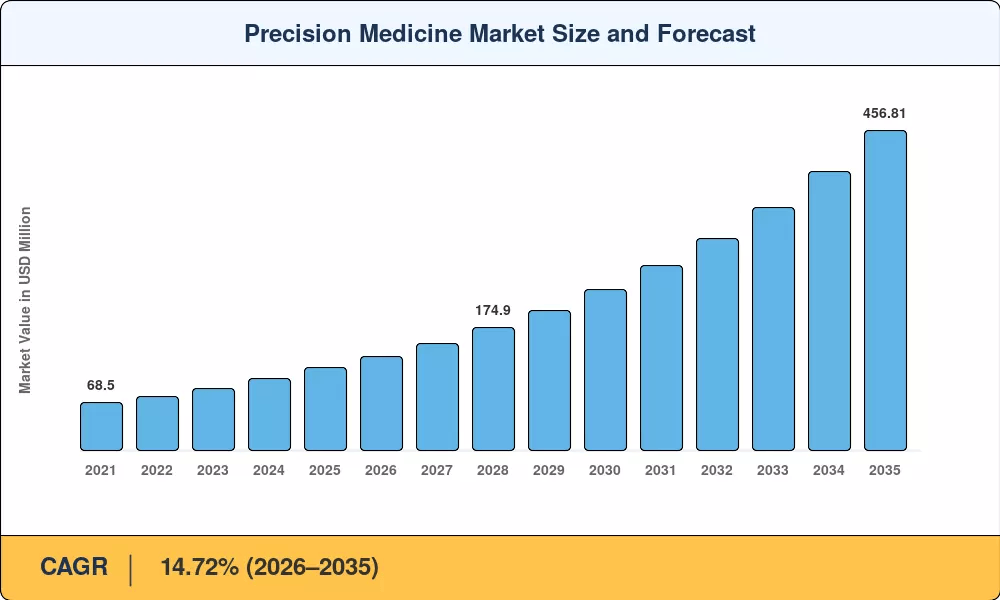
Precision Medicine Market Size
Precision Medicine Market to Surge from USD 134.10 Billion in 2026 to USD 456.81 Billion by 2035— Powered by AI Diagnostics, Genomics Programs
NY, CA, UNITED STATES, June 8, 2026 /EINPresswire.com/ -- As per Market Research Future, the global Precision Medicine Market size to reach USD 456.81 Billion by 2035 from USD 134.10 Billion in 2026, at a CAGR of 14.72% during the forecast period 2026–2035. The market base was estimated at USD 118.23 Billion in 2025.The 14.72% CAGR—nearly four times the growth rate of the broader pharmaceutical sector—is driven by three converging structural forces: the declining cost of genomic sequencing (now below USD 200 per genome, a 95% reduction from 2015), the regulatory acceleration of companion diagnostic co-development pathways, and the emergence of AI-native platforms capable of delivering treatment recommendations from multi-omic patient data within 48 hours.
National governments are amplifying this momentum. The U.S. All of Us Research Program has enrolled over 800,000 participants and committed USD 3.1 billion to sequence one million genomes. The EU’s European Health Data Space regulation, adopted in June 2024, will enable secondary use of health data across all 27 member states by 2027.
India’s Genome India Initiative has announced a USD 280 million expansion to sequence 100,000 genomes by 2027. Together, these initiatives are creating the population-scale datasets on which pharmacogenomics drug matching and biomarker-driven therapy development depend.
Request A Free Sample: https://www.marketresearchfuture.com/sample_request/925
Key Market Trends & Growth Drivers
National Genomics and Biobank Infrastructure
Government-funded genome sequencing programs are the single largest structural driver of the Precision Medicine Market through 2035. Biobank programs at population scale—including Genomics England’s 100,000 whole-genome sequences linked to NHS clinical records, China’s National Genomics Data Center holding over 3.8 petabytes of sequencing data, and South Korea’s K-MASTER precision oncology program—are collectively creating competitive biomarker discovery environments across all major geographies.
Early-adopter health systems report adverse drug reaction rate reductions of an estimated 25% when pharmacogenomics drug matching is integrated into prescribing workflows.
AI and Machine-Learning Diagnostic Platforms
The FDA approved 171 AI/ML-enabled medical devices in 2024 alone, a 35% year-over-year increase. Platforms from companies such as Tempus and Foundation Medicine can analyze multi-omic patient profiles and deliver individualized cancer treatment recommendations in under 48 hours—compressing timelines that previously required weeks of specialist consultation.
McKinsey estimates that AI-augmented personalized treatment plans could reduce drug development costs by 30–40% across the pharmaceutical value chain, making this the fastest-growing technology segment at a 19.3% CAGR through 2035.
Companion Diagnostic Regulatory Reform
The FDA’s 2023 revision to companion diagnostic guidelines reduced co-development review durations from approximately 12 months to roughly 7, enabling sponsors to submit biomarker assay data concurrently with pivotal trial results. The EMA introduced a comparable parallel scientific guidance structure in early 2024.
In May 2025, Roche received FDA approval for the VENTANA MET (SP44) RxDx Assay as a companion diagnostic for non-squamous non-small cell lung cancer—a milestone illustrating how regulatory reform is directly accelerating targeted molecular therapy commercialization. In January 2025, the FDA finalized updated pharmacogenomics guidance introducing a streamlined 510(k) pathway expected to accelerate time-to-market by 30%.
Ask for Customization: https://www.marketresearchfuture.com/ask_for_customize/925
Market Segment Insights
BY TECHNOLOGY
Next-Generation Sequencing: Dominant segment with ~38% share in 2025. Cost per genome below USD 200; NCCN and ESMO guidelines mandate NGS for 15+ tumor types. Illumina’s NovaSeq X Plus platform reinforces market leadership.
AI & Machine Learning: Fastest-growing technology at 19.3% CAGR (2026–2035). FDA approved 171 AI/ML medical devices in 2024. Platforms process multi-omic data for biomarker-driven therapy selection within 48 hours.
Bioinformatics & Big Data Analytics: Combined USD 28.4 Billion revenue in 2025. Supports real-world evidence generation and pharmacogenomics drug matching at population scale.Other Technologies (CRISPR, Proteomics): 13.1% CAGR (2026–2035), representing next-generation diagnostic frontiers.
BY APPLICATION
Oncology: Dominant application with ~43.5% share in 2025. Comprehensive tumor profiling is now standard of care in breast, lung, and colorectal cancers. Liquid biopsy expanding individualized cancer treatment into longitudinal monitoring.
Rare & Genetic Disorders: Fastest-growing at 17.1% CAGR. FDA issued 589 orphan drug designations in 2024. Expanding newborn genomic screening programs create lifetime personalized treatment pathways.
Neurology: USD 8.4 Billion in 2025, driven by Alzheimer’s biomarker diagnostics.
Infectious Diseases: 14.8% CAGR (2026–2035), fueled by pathogen genomics and antimicrobial resistance surveillance.
Cardiology: ~7% share; pharmacogenomics-guided anticoagulant dosing is the primary use case.
BY END USER
Pharmaceutical & Biotechnology Companies: Largest segment at ~48% share in 2025, investing in companion diagnostic co-development and biomarker-stratified trial enrichment.
Hospitals & Clinical Laboratories: USD 26.8 Billion in 2025, with point-of-care genomic testing gaining traction.
Home-Care Settings: Fastest-growing end user at 17.0% CAGR, reflecting decentralized healthcare delivery and direct-to-consumer genomic testing platforms.
Academic & Research Institutes: ~12% share; federally funded genomics research remains a foundational demand driver.
Read Detailed Insights: https://www.marketresearchfuture.com/reports/precision-medicine-market-925
Regional Outlook
North America — Dominant Market (~45% Share, 2025)
The United States generates approximately 82% of North American Precision Medicine Market revenue, driven by NIH annual grants exceeding USD 1.5 billion for genomics research, broad commercial payer adoption of pharmacogenomics panels, and a regulatory environment that rewards biomarker-stratified drug approvals with priority review vouchers. CMS’ 2024 expansion of pharmacogenomics coverage is a direct revenue catalyst expected to add USD 4.2 billion in annual testing revenue by 2028. Canada is growing at a 10.5% CAGR on pan-Canadian genomics networks.
Europe — Second Largest (USD 30.7 Billion, 2025)
Europe’s Precision Medicine Market benefits from centralized health-data infrastructure and the transformative European Health Data Space regulation, which enables secondary use of health data across all 27 EU member states when fully implemented by 2027. Germany leads regionally with the BioNTech ecosystem and Fraunhofer diagnostics research. The UK is growing at 14.8% CAGR anchored by the UK Biobank and NHS Genomic Medicine Service. France’s Plan France Médecine Génomique 2025 and the Nordic countries’ FinnGen and deCODE Genetics population studies further underpin European market depth.
Asia-Pacific — Fastest-Growing Region (15.8% CAGR, 2026–2035)
Asia-Pacific is the highest-growth corridor in the Precision Medicine Market. China’s National Genomics Data Center holds over 3.8 petabytes of sequencing data and NMPA’s streamlined companion diagnostic review pathways are accelerating market entry. India is growing at 17.2% CAGR on the back of the Genome India Initiative’s USD 280 million expansion and a rapidly scaling clinical-trial outsourcing sector. Japan contributes USD 6.8 Billion (2025) through AMED-funded biobank integration. South Korea’s K-MASTER program is growing at 16.1% CAGR. The region accounted for USD 23.6 Billion in 2025.
Middle East & Africa — Emerging Opportunity (12.9% CAGR, 2026–2035)
Saudi Arabia’s Vision 2030 health transformation agenda and the Saudi Human Genome Project (100,000+ genomes sequenced) are establishing the biomarker databases for domestic precision oncology. The UAE’s Dubai Genomics Corridor is growing at 14.3% CAGR, supported by medical tourism. Sub-Saharan Africa’s H3Africa consortium is expanding biomarker-driven therapy research for populations historically underrepresented in global genomic databases—addressing a long-standing health equity gap.
South America — Growing Presence (USD 5.3 Billion, 2025)
Brazil anchors South America’s Precision Medicine Market at ~56% of regional revenue, with FIOCRUZ driving public-sector genomics investment and expanding pharmacogenomics coverage under the Unified Health System. Argentina’s academic medical centers are emerging as regional hubs for individualized cancer treatment clinical trials, growing at 13.4% CAGR.
Competitive Landscape and Recent Developments
The Precision Medicine Market exhibits moderate concentration, with the top five players accounting for an estimated 28–34% of global revenue. The Herfindahl-Hirschman Index sits in the low-to-moderate range (~600–800), reflecting a market where significant competitive barriers exist in data aggregation and regulatory expertise rather than outright monopoly.
The competitive landscape is stratified between large-platform integrators controlling end-to-end data and diagnostic workflows, mid-sized specialty firms focused on specific therapeutic areas, and AI-native disruptors reshaping discovery economics.
KEY COMPANIES AND RECENT MILESTONES
Illumina (September 2024): Launched the NovaSeq X Plus 25B flow cell, doubling clinical throughput and reducing per-sample sequencing costs by 20%. Estimated revenue share: ~8–11% of global Precision Medicine Market.
Roche / Foundation Medicine (November 2024): Received FDA approval for FoundationOne Liquid CDx as a companion diagnostic for three additional targeted molecular therapy indications in non-small-cell lung cancer. Estimated revenue share: ~7–10%.
Tempus (March 2025): Completed IPO on NASDAQ, raising USD 410 million to expand its AI-driven data platform and international biomarker analytics capabilities. Estimated revenue share: ~3–5%.
BioNTech (April 2025): Reported positive Phase II data for individualized neoantigen cancer vaccine BNT122 with a 44% reduction in disease recurrence in melanoma patients. Estimated revenue share: ~2–3%.
Future Outlook: 2026–2035
By 2030, AI-driven clinical decision support systems are expected to influence over 60% of oncology treatment selections in Precision Medicine Market leader countries, integrating multi-omic patient data, real-world outcomes, and pharmacogenomics algorithms into unified clinical dashboards. Decentralized clinical trials incorporating wearables, remote monitoring, and at-home sample collection are projected to represent 40% of Phase II/III precision oncology trials by 2028, improving patient diversity and reducing trial dropout rates by 25%.
The next decade will see market consolidation around data-platform companies that aggregate genomic, clinical, and payer datasets at scale—creating recurring-revenue streams that mirror SaaS economics. WHO’s Genomics Implementation Strategy, launched in 2024, calls for 50 low- and middle-income countries to establish pharmacogenomics drug matching capabilities by 2030, underscoring that health equity and commercial expansion are now aligned forces driving the Precision Medicine Market to its USD 456.81 Billion 2035 destination.
More Related Research Insights:
https://www.marketresearchfuture.com/reports/genomics-market-12283
https://www.marketresearchfuture.com/reports/bioinformatics-market-2265
https://www.marketresearchfuture.com/reports/pharmacogenomics-market-1177
https://www.marketresearchfuture.com/reports/companion-diagnostic-market-3077
https://www.marketresearchfuture.com/reports/molecular-diagnostics-market-1171
https://www.marketresearchfuture.com/reports/next-generation-sequencing-market-6354
https://www.marketresearchfuture.com/reports/liquid-biopsy-market-710
https://www.marketresearchfuture.com/reports/biomarker-market-1941
https://www.marketresearchfuture.com/reports/cancer-diagnostics-market-1962
https://www.marketresearchfuture.com/reports/personalized-medicine-market-2937
Larry Wilson
WantStats Research And Media Pvt. Ltd.
+1 855-661-4441
email us here
Visit us on social media:
LinkedIn
Facebook
YouTube
X
Legal Disclaimer:
EIN Presswire provides this news content "as is" without warranty of any kind. We do not accept any responsibility or liability for the accuracy, content, images, videos, licenses, completeness, legality, or reliability of the information contained in this article. If you have any complaints or copyright issues related to this article, kindly contact the author above.
